
YOUR SUPPORT IN ACTION
For over 20 years, BSNCF has uplifted the spirits of those battling cancer—granting wishes, gifting care packages, offering humanitarian support, and funding research.

Comfort Bags
Comfort bags brought smiles to newly diagnosed GYN-cancer patients at Greater Baltimore Medical Center.
READ MORE
Thanks to our donors, 125 equipped "Comfort Bags" provided moments of joy to gynecologic cancer patients. Totes were filled with useful items: a cozy blanket, a cookbook, a chair-exercise book, an awareness ribbon pin, a clip-on hand sanitizer, a BSNCF water bottle, a Vitamin E hand cream, a Biotene dry mouthwash, a Tea Tree nail saver, and Quesy Pops for infusion patients.
In 2017, we expanded and renamed the Comfort Bags program as “Smile Packages” to build on its success and reach more patients. This change reflected our commitment to broadening the program’s impact while continuing to provide moments of joy to gynecologic cancer patients.

Lee's Friends
Since 2006, BSNCF has partnered Lee’s Friends each year to provide humanitarian grants to hundreds of gynecologic cancer patients.
READ MORE
Lee’s Friends supports patients of all ages and stages, from diagnosis to cure or through bereavement. Their mission is to provide emotional and practical support to cancer patients and families during diagnosis and treatment. Our partnership enabled rides to appointments and helped with essential daily needs.
Death was not an issue—living was.

The Wish Fund
BSNCF enabled the creation of “The Wish Fund,” which grants the patient and their family the “wish” of their choice.
READ MORE
This included trips, special meals, and VIP shows. Special VIP experiences, such as treating a Stage 4 patient and their family, a chance to attend an Orioles game in box seats, complete with a scrumptious dinner and souvenirs. The Wish Fund also delivered a special crab cake dinner to a patient in hospice at home who said they would love “one last crab cake.” Other wishes fulfilled included fresh-flower deliveries, concert experiences, and getaways. This fund provides an invaluable gift to patients during cancer treatment and at the end of life.
This program inspired our 2017 stretch goal to create celebrity experiences for cancer patients and their families.

Patient Navigator
BSNCF funded the establishment of a much-needed Patient Navigator at The Lapidus Cancer Institute at Sinai Hospital.
READ MORE
The Patient Navigator position offered navigational assistance to oncology patients and their caregivers through the continuum of care. By assessing the patient’s needs and linking patients to community agencies that provide housing, appropriate oncology educational materials, and social services, care was significantly improved.
The Patient Navigator provided logistical support for the patient in the following ways:
- Contacted patients to schedule and reschedule missed appointments.
- Met with patients before they started chemotherapy or radiation therapy.
- Served as liaison between the treating physician and the patient.
- Identified patients who need navigation and assistance with barriers such as lack of insurance, financial issues, need for personal support, language, and any unexpected problems that arise during treatment.
- Retrieved medical records as needed.
- Provided health education and community outreach.
- Worked in conjunction with the family, medical staff, and administration to provide quality comprehensive care to patients, and ensure that barriers to treatment are overcome.
- Provided assistance with supportive care needs such as prosthetics, wigs, durable medical equipment, etc.
The Navigator also assisted with access issues, including insurance and financial forms, and with arranging transportation. This service significantly eased stress for patients and loved ones.

Caregiver Workshop
BSNCF sponsored a caregiver workshop given by Amy Sales, author of “Walking on Eggshells.”
READ MORE
“Walking on Eggshells” is a simple yet practical guide for caregivers of those with a life-limiting disease. Caregivers are the silent heroes who walk the journey alongside their loved ones, and they often fear not knowing what to do, being afraid of saying the wrong thing, or just not knowing what to say. Amy’s workshop and book provide support through education, humor, and suggestions for navigating an uncharted journey.
The Foundation understands that it is often not only the patient, but also the patient’s family and friends, who are dealing with this disease.

Patient Resource Guide
Understanding how intimidating a first visit to a cancer center can be, BSNCF offers solutions to help patients navigate.
READ MORE
Recognizing the need to give patients as much useful information as possible on that first visit is important. BSNCF enabled the establishment of a new, comprehensive Patient Handbook listing the many services and programs offered through Greater Baltimore Medical Center’s (GBMC) cancer program. The handbook was given to every new patient at their first visit with their oncologist or at the start of infusion therapy.
Patients were encouraged to use the handbook to organize all health care information received or needed during their treatment. This includes patient education materials, treatments, medications, appointment calendars, pain management, test results logs, and support resource listings.
Inspired by the success of this initiative, BSNCF will include a journal in our Smile Package to allow patients to keep their notes in one place.

Stress-Reducing Aquarium
BSNCF funded an aquarium for the patient waiting room at Greater Baltimore Medical Center.
READ MORE
The aquarium and aquatic life brought the calming effect of nature to thousands of patients and caregivers waiting for treatment, reducing stress and anxiety. We were thrilled to have the opportunity to build on our previous funding to refurnish the waiting room.
Intuitively, we know that the sound of running water is one of the most soothing environmental stimuli. Watching fish swim back and forth is stress and anxiety-reducing. The gurgling sound of the bubbles adds to the therapeutic effect of looking at the tank.
Studies have shown that there are health and emotional benefits to having an aquarium. A 2004 study by Purdue University examined the effects of an aquarium on patients awaiting therapy. The study investigated the effect of an aquarium on pre-treatment anxiety, fear, frustration, and depression. While statistically significant differences in blood pressure and heart rate between the test and control were not found, the patients demonstrated a 12% reduction in self-reported pre-treatment anxiety.
Stella Maris Hospice Support
BSNCF assisted in continuing this valuable programming supporting terminally ill patients and their families.
READ MORE
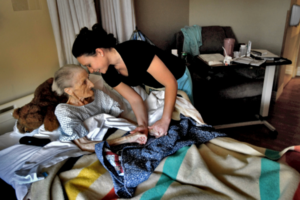
Stella Maris’ Hospice program is offered to patients who have a life-threatening disease and who have less than six months to live. Following is an account about the positive impact that Stella Maria had written by Courtney Barnett in 2003:
“At age 23, I have already had three very close and personal experiences with the Stella Maris Hospice program. I am the daughter of Mary Barnett, one of the people who inspired the Barnett-Searing National Cancer Foundation.
From ages 15 to 22, I learned a lot about the Hospice program. My first two experiences were due to my grandparents’ illnesses. My grandmother lived with us during her hospice care until a week before her death. Her last days were spent at Stella Maris. My grandfather was in the Assisted Living section of a retirement community. Hospice provided a social worker, some nursing care, religious support, and more. After these initial experiences, I can say that the two words that come to mind regarding hospice are “caring” and “respect”. My father says that he doesn’t know what he would have done if it had not been for the hospice program at Stella Maris.
Unspeakably, we would need the support of Hospice again for my mother’s care. There are so many moments that I vividly remember from the day I was told my mom had been diagnosed with cancer. One moment I know I won’t forget was when my father sat me down, shed a few tears, and told me my mother’s oncologist had suggested hospice that day. From my past experiences, I knew then how much the cancer had progressed and that, more than likely, I would not have a mom much longer.
Once again, Hospice did wonders. The Hospice nurse came to our home and immediately tended to my mother. Realizing how uncomfortable and anxious my mom was, she immediately made phone calls to get a medication that could ease her pain and anxiety, and ultimately calm her breathing. We were able to give my mom a dose of medicine within an hour.
During my mom’s illness and after her passing, Hospice offered my whole family counseling. Hospice offers single, family, and group counseling. This is a very positive aspect of Hospice. It is so beneficial to the family members to be able to talk to someone who regularly assists those who are dealing with the loss of a loved one. It helped me gain some perspective on the feelings and emotions I was experiencing. Programs such as these help families continue with their lives, even if it is minute by minute, day by day, and eventually, year by year.”
The Barnett-Searing National Cancer Foundation was honored to work with such a giving partner.

Dr. Ramirez Cancer Research
BSNCF donated funds to the University of Texas MD Anderson Cancer Center for cancer research.
READ MORE
The contribution was designated for a clinical research study conducted by Dr. Pedro Ramirez, which aimed to determine whether blood tests and CT scans for gynecologic cancer patients could be used to select the optimal treatment sequence. For example, the study aims to determine whether chemotherapy followed by surgery yields better outcomes in patients with advanced disease.
Pedro T. Ramirez, M.D., is a Professor and the Director of Minimally Invasive Surgical Research and Education in the Department of Gynecologic Oncology at MD Anderson Cancer Center. He oversees surgeons' training in techniques such as laparoscopy and the da Vinci Robotic Surgical System. These techniques today not only enhance surgeons’ skills but also improve patients’ quality of life by decreasing pain and blood loss, reducing hospital stays, and facilitating quicker returns to daily activities when compared with conventional open surgical techniques.
Dr. Ramirez has extensive hands-on experience with these techniques. Specifically, he is known for his use of total laparoscopic radical hysterectomy and laparoscopic extraperitoneal lymph node dissection in patients with early and locally advanced cervical cancer, respectively. Furthermore, Dr. Ramirez has a great deal of experience in performing robotic radical hysterectomies, radical trachelectomies, radical parametrectomies, and staging procedures. He is also recognized as one of the leading surgeons in this country in the field of fertility preservation in young women with early cervical cancer.
Dr. Ramirez has authored and co-authored over 125 scientific publications and has written numerous book chapters, monographs, and invited articles. He has also served on various committees and academic societies, including as President of the Houston Gynecologic and Obstetrical Society and as Chair of the Gynecologic Oncology Special Interest Group of the American Association of Gynecologic Laparoscopists.
Dr. Ramirez is also committed to educating physicians worldwide. For example, he frequently speaks at international surgical conferences. In addition, Dr. Ramirez serves as a mentor and host to numerous international surgeons seeking to expand their expertise and skills. He is a frequently invited lecturer for national and international conferences and meetings, where he continues to foster international scientific collaboration.
BSNCF is pleased to contribute to the progress in cancer research by such talented experts in the medical field.

Waiting Room Renovation
In memory of Mary Barnett, BSNCF refurbished the cancer center waiting area at Greater Baltimore Medical Center (GBMC).
READ MORE
After receiving the Foundation’s donation, GBMC’s Dr. Gary Cohen said, “Support from donors, such as BSNCF, is critical to maintaining the excellence that our patients have come to expect and appreciate. We know that the new waiting area, freshly painted and newly furnished, will provide our patients and their families with a more positive environment as they wait for appointments and treatments.”

Dr. Berkowitz Cancer Research
BSNCF donated to the Dana-Farber Cancer Institute to support Dr. Ross Berkowitz’s research on gynecological cancer.
READ MORE
The study focuses on early diagnosis of the disease through blood tests and other screening methods before advanced disease develops, thereby increasing the treatment window.
Dr. Berkowitz is the William H. Baker Professor of Gynecology at Harvard Medical School. He is the Director of Gynecologic Oncology and Gynecology and Co-Director of the New England Trophoblastic Disease Center at the Brigham and Women’s Hospital and the Dana Farber Cancer Institute.
Over the past 20 years, Dr. Berkowitz’s research has focused on gestational trophoblastic disease and ovarian neoplasia. Investigations in these areas have resulted in more than 400 publications, including original reports and reviews. Concerning gestational trophoblastic disease, his research interests have focused on identifying risk factors for the development of these tumors and advancing understanding of their natural history, including subsequent reproductive experience.
BSNCF was honored to contribute to finding a cure.